Integrating a Jesus Loves You SVG Design into Your Creative Workflow
In the intersection of faith and digital design, few assets carry as much weight and versatility as a well-crafted “Jesus Loves You” SVG design. Whether you are a small business owner looking to create meaningful merchandise, a church media director preparing next week’s sermon graphics, or a hobbyist crafter making gifts for friends, this simple vector file serves as a foundational building block. This article explores the practical role of this design asset, examining how it fits into real-world planning, execution, and long-term creative strategy. We will move beyond the file itself to look at the workflows it enables and the processes it streamlines.
Understanding the Asset: More Than Just a Pretty File
An SVG, or Scalable Vector Graphic, offers a distinct advantage over raster images like JPEGs or PNGs. It can be scaled up to billboard size or down to a business card without losing quality. For a design centered on a powerful message like “Jesus Loves You,” this means one source file can serve a multitude of purposes across vastly different mediums.
However, integrating an SVG into a project is not merely a matter of downloading and inserting. It requires a degree of pre-planning that directly impacts the quality of your final output. Is the design suited for the intended medium? A highly intricate SVG with delicate lines might look stunning in a digital greeting but could fail to cut properly on a Cricut machine for a t-shirt design. Understanding the technical boundaries of your output method is the first step in a successful workflow.
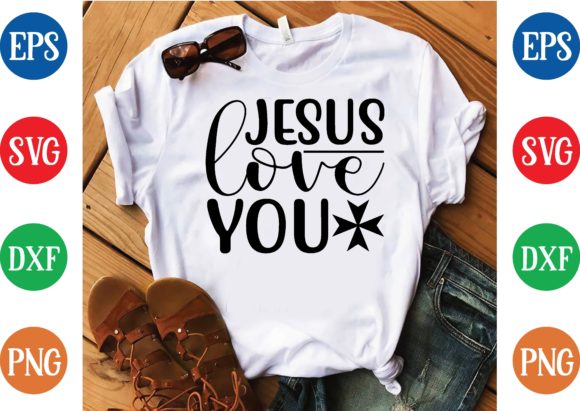
The visual structure of the design itself varies widely. A bold, blocky text SVG is perfect for durable apparel. A script font with flourishing crosses fits beautifully on home decor or digital quote cards. A layered SVG, where the text and icons are separate elements, offers maximum flexibility for color changes and resizing without breaking the design’s integrity. Recognizing these differences early saves significant time during the execution phase.
Defining Your End-Use Case
Before you even open the SVG file, clearly define the project’s objective. Are you creating a single, one-off gift, or are you producing 100 units for an online store? The volume and purpose dictate your preparation steps.
For commercial entrepreneurs, licensing is the first checkpoint. A high-quality SVG design often comes with specific usage rights. Some designers grant full commercial rights, while others require a separate extended license. Verifying this immediately prevents legal disruptions and inventory headaches later in your business workflow.
For church media teams, the design must align with the current sermon series or brand guide. Does the typography match your church's visual identity? Preparation here involves having an organized asset library where SVGs are tagged by theme, such as “Grace,” “Salvation,” or “Easter,” allowing for rapid retrieval when a deadline looms.
Software and Platform Compatibility
The effectiveness of a Jesus Loves You SVG design is entirely dependent on the software environment it is used in. Adobe Illustrator allows for deep manipulation of anchor points and paths, making it ideal for custom modifications and creating variations. Cricut Design Space or Silhouette Studio will read the file natively for cutting, but they sometimes struggle with overly complex nodes or unclosed paths. Canva Pro accepts SVGs natively, which is excellent for non-designers who need to produce social media graphics quickly.
A practical workflow tip is to keep an unaltered master copy of the SVG in a dedicated archive folder. Always work on duplicates of the file. This simple habit preserves the original quality and allows you to revert to a clean base if a modification goes wrong. It also ensures you always have a version that is fully editable for future projects.
The Print-on-Demand Product Pipeline
An entrepreneur selling Christian apparel on platforms like Etsy or Shopify relies heavily on design efficiency. The process typically follows a distinct pattern:
- Market Research: Identify a specific niche, such as “Jesus Loves You” designs for baby onesies or minimalist versions for workout gear.
- Design Selection: Choose an SVG that fits both the niche and the product medium. A distressed SVG works well for a vintage-style tee, while a clean, solid design is better for embroidery.
- Mockup Generation: Use tools like Placeit or Printful’s mockup generator. An SVG integrates seamlessly into these templates because it can be resized without losing sharpness.
- Production Handoff: Upload the final design file to the print provider. The vector nature of SVG guarantees the design prints cleanly at any requested size, from a small pocket logo to a large back print.
The bottleneck in this pipeline is often the gap between design selection and mockup generation. Using standard, well-constructed SVGs with proper layers and clean paths can shave minutes off each product listing. Over a large catalog, this time savings is substantial.
Church Media and Sermon Series Execution
For a communications director or media volunteer, the workflow is cyclical and tied to the church calendar. The need for consistent, high-quality visuals is constant.
- Theme Articulation: The pastor decides on a series, such as “The Love of the Father.”
- Asset Sourcing: The media team pulls a Jesus Loves You SVG that matches the series’ color palette and stylistic direction, whether modern, traditional, or rustic.
- Multi-Platform Distribution: The SVG is used to generate a title slide for presentation software, a square graphic for Instagram, a cover photo for Facebook, and a header for the church website.
- Quality Assurance: Check readability on a projector screen, where contrast is critical, and on mobile devices. An SVG with strokes that are too thin will disappear when projected in a large auditorium.
The true efficiency gain comes from creating a master template in your editing software, such as Adobe Photoshop or Affinity Publisher, where the SVG is placed as a smart object. Changing the background or adjusting the layout for different platforms becomes a matter of minutes, not hours.
Personal Crafting and Gift Creation
Hobbyists often have the most tactile and hands-on workflow. The SVG is the bridge between a digital idea and a physical object.
- File Acquisition and Preparation: Downloading the SVG and uploading it to Cricut Design Space or Silhouette Studio.
- Weeding and Assembly: A clean SVG with distinct, disconnected parts, such as text separated from an image, makes the weeding process significantly faster. An SVG where every element is merged into a single path can be a nightmare to weed, especially with small, intricate text.
- Application: Using heat transfer vinyl or adhesive vinyl. A well-designed SVG considers the direction of application and avoids overly thin bridges that will tear.
For the hobbyist, the workflow is less formal but equally important. Organizing SVGs by holiday, recipient, or type, such as naming a file HTV_Jesus_Loves_You_Red.svg, directly impacts the joy and speed of the creative process.
Building an Asset Library
Professionals and hobbyists alike benefit from treating SVGs as a library of resources. Instead of scouring the internet for a specific design every time a new project arises, maintain a categorized collection.
- Use a consistent naming convention, such as
Theme_Style_Text_Variant.svg(e.g.,Faith_Modern_JESUS_Loves_You_Cross.svg). - Use cloud storage like Google Drive, Dropbox, or Creative Cloud for accessibility across multiple devices and team members.
- Keep a “favorites” or “core” folder for the most versatile and high-performing SVGs that align with your brand identity.
Quality Control and Pre-Flight Checks
Before finalizing any project, perform a quick pre-flight check on the SVG file. This saves time and materials.
- Scalability: Open the SVG and zoom to 200 percent. Are the lines still crisp? Are there any jagged edges or broken curves?
- Color Separation: If multiple colors are needed in a cut file, are the elements properly separated into distinct objects or layers? A single-color design is simpler, but a multi-color SVG saves cutting time.
- Font Outlining: Are the texts converted to paths or outlines? If not, your software might substitute a different font, ruining the intended typography. Always check that the SVG contains paths, not live text, unless you have the specific font installed on your system.
Consistency Across Projects
A brand—whether it belongs to a church, a blog, or a store—thrives on visual consistency. Using a specific set of Jesus Loves You SVG designs that align with your brand voice builds recognition and trust. Stick to two or three core styles, such as one script option, one modern sans-serif option, and one option with a specific cross icon. Using too many disparate styles dilutes the visual message and confuses the audience.
Adapting the Workflow for Scalability and Growth
As your project or business grows, your asset management process must evolve. What works for 10 products or 10 social posts will become inefficient at 100 or 1,000.
Learning to use batch processing or actions in graphic software can apply your core Jesus Loves You SVG to dozens of mockups or social templates at once. This transforms a repetitive task into a single automated step, freeing up time for creative exploration or strategic planning.
Pay close attention to feedback loops. Monitor which designs resonate most with your audience. If a particular style of Jesus Loves You SVG consistently gets more engagement on Instagram or sells better in your online shop, prioritize creating variations of that style. Your audience’s reaction is a direct signal that should inform your future production workflow.
Delivering the Message Through Process
The Jesus Loves You SVG design is a powerful piece of digital real estate. Its true value, however, is unlocked not just by its visual appeal, but by its seamless integration into a well-thought-out process. Whether you are streamlining production for a business, unifying a message for a church, or simply bringing joy through a handmade gift, treating this file as a core component of your workflow ensures consistency, efficiency, and quality. By focusing on preparation, tool compatibility, organization, and long-term asset management, you ensure that the message you are creating is as effective and far-reaching as possible. The goal is not just to design, but to deliver with intention.